A ‘beautiful smile’ is often sought by patients requesting lip fillers, as smiling is one of the most important non-verbal ways of expressing emotions [1]. However, achieving an appealing smile when performing lip enhancement can be a challenging task.
When planning for lip enhancement, practitioners should respect the uniqueness of every smile and individually assess each case. Although there is no perfect recipe, the goal of treatment is to achieve a smile that is in harmony with the face [2,3]. An initial step in planning lip enhancement involves requesting the patient to pose not only at rest but also in a smiling position. This helps plan a smile that is harmonious with the teeth, gingival scaffold and facial features, thereby achieving a natural and balanced result. Three key factors that an aesthetic practitioner should consider when creating a ‘perfect’ smile are the lip framework, the teeth and the gingiva exposure [2,3].
Lip framework
Research has indicated that the most desirable lips are fuller, with a golden (φ) 1:1.6 ratio of upper to lower vertical height, and about 2mm of upper lip projection over the lower lip in profile [4]. Although preferences vary by ethnicity, the ratios mentioned above have gained popularity worldwide, possibly due to the widespread use of social media [5]. Lips should also be in balance with the nose, the maxilla and the mandible; therefore, the use of profile assessment tools such as the Steiner, Rickett’s and Burstone lines has been recommended to examine whether filler should be additionally placed in the perioral area to ensure a balanced profile view [6]. Furthermore, neuromuscular factors and the stages of smiling should be taken into consideration.
The extent of a smile is determined by the interaction between the static and dynamic relationships of the dento-skeletal and soft tissue components of the face [7]. There are two stages involved in the formation of a complete smile. First, the levator muscles elevate the upper lip to the level of the nasolabial fold (NLF). At a second stage, the upper lip and NLFs are further elevated by the levator labii superioris muscles of the upper lip (originating from the infraorbital region), the zygomaticus major muscles and the superior fibres of the buccinator [7].
The upper lip curvature and smile symmetry (positioning of the oral commissures in the vertical plane) are muscle-driven positions. In general, symmetric smile lines, characterised by an oblique commissural line and upward or straight lip curvatures, are regarded as more aesthetically pleasing [8].
Gingiva
A beautiful smile should incorporate healthy-looking gingiva. Healthy gingiva has a stippled and firm texture. The dental papilla should fill the interdental space, leaving no ‘black triangles’ between adjacent teeth and be evenly aligned. Ideally, the gingival margins should be the same for the central incisors and canines and slightly higher than those at the lateral incisors. Furthermore, the amount of gingiva displayed upon smiling is considered ‘aesthetically pleasing’ when up to 2mm [3,9–11].
Teeth
Teeth are essential for the support of the lips. The shape of the lips depends on the shape and size of the underlying teeth, their position (i.e. rotations and spacing), and the midline coincidence of the upper and lower teeth. The alignment of the teeth and the type of occlusion (Class I, II, III) influence not only lip support but also the overall profile view of an individual. In general, a Class I occlusion as decribed by Angle back in 1900 (the mesio-buccal cusp of the upper first molar occludes into the groove of the lower first molar, the cusp of the upper canine rests between the lower canine and first premolar, and the upper anterior teeth are positioned 2–5mm anterior to the lower anterior teeth) is regarded as most aesthetically pleasing [3,11].
Additionally, in an ideal smile arc, the curvature of the maxillary incisal edges aligns with or parallels the border of the lower lip upon smiling [8]. Other characteristics of teeth to consider when designing a smile include colour, with a whiter shade being preferable, and anterior teeth exposure, where, when laughing with an open mouth, a person’s teeth should be visible [11].
Treatment approaches
Lip enhancement is typically performed using hyaluronic acid (HA) fillers. However, sometimes lip augmentation should be complemented by additional filler in the perioral area, neurotoxins and teeth alignment. Below, we present some cases where a multi-faceted approach has been adopted.
Case 1: 29-year-old requesting mild lip augmentation and correction of gummy smile at the canine and premolar areas
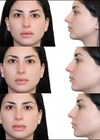
The clinical examination revealed that the gummy smile around the canine and premolar regions was due to insufficient alveolar support, which also caused a concavity in her profile view (Figure 1).

Figure 1 (Case 1): Before treatment. Top: Smile position, Bottom: Rest position and profile views.
Therefore, the patient was advised to have the HA filler placed not only in the lips but also to enhance the maxilla at the canine and premolar sites. Accordingly, a dense HA filler was injected into the pyriform aperture areas (0.2ml per side) and the NLFs and white lip area (0.3ml per side), aiming at providing structural support and increasing the resistance of the lip upon smiling. A lip indicated HA filler (0.5ml, tented technique) was additionally administered in the upper and lower lips to enhance their shape (Figure 2).

Figure 2 (Case 1): After treatment. Top: Smile position, Bottom: Rest position and profile views.
Case 2: 34-year-old requesting fuller lips
The examination showed a gummy smile caused by an imbalance in the strength and resistance of the levator muscles (the upper lip did not get thinner upon smiling). From a profile view, a Class II, Division 2 occlusion (retrognathia, a strong mentalis muscle and a deep mentolabial fold) was visible (Figure 3).

Figure 3 (Case 2): Before treatment. Top: Smile position. Bottom: Rest position and profile views.
The patient was advised to have her perioral area treated along with her lips to achieve a balanced aesthetic outcome. Accordingly, a dense HA filler was injected into the chin (0.2ml) and jawline (0.3ml per side), while a filler with medium elasticity and cohesivity that allows facial movement was applied to the mentolabial fold (0.3ml), NLFs (0.1ml per side) and lips (0.5ml) (Figure 4).

Figure 4: After treatment. Top: Smile position. Bottom: Rest position and profile views.
Case 3: 40-year-old patient requesting lip filler
The clinical examination revealed a gummy smile due to excessive mechanical action from the zygomatic muscles, resulting in a lateral elevation of the patient’s mouth corners and a wide smile with visual molars. A lack of lip support on the patient’s right side, due to a lateral incisor with inward rotation, was also noticeable (Figure 5, top image).

Figure 5 (Case 3): Top: Before, smiling position. Bottom: Straight after the botulinum toxin and lip filler treatment.
The first issue to address was muscle strength; therefore, relaxation using OnaBoNT-A at the Yonsei point (2IU per side) was performed along with mild augmentation (0.5ml) using HA filler indicated for the lip area (Figure 5, bottom image). Two weeks later, further lip enhancement was performed, and a full correction of the gummy smile was achieved (Figure 6).

Figure 6 (Case 3): Further lip enhancement to fully correct the gummy smile.
However, the upper- right lip was not supported equally to the upper-left lip, causing it to turn inward at the lateral incisor area and resulting in an ‘unpleasing’ (as the patient described) smile. Therefore, the patient was advised to have teeth alignment to ensure equal lip support.
Since the patient had existing old composite fillings, bridges and previous root canal treatments, she was advised to have zirconia crowns placed. The dental treatment, due to its complexity, lasted six months; therefore, some filler had been absorbed (Figure 7).

Figure 7 (Case 3): After the prosthodontic treatment and a second session of toxin.
Subsequently, following the placement of the dental work, a final session for lip augmentation with 0.5ml HA filler for lips was conducted to restore some lost volume and achieve an optimal result (Figure 8).

Figure 8 (Case 3): Last session with lip filler.
Case 4: 32-year-old patient requesting lip filler
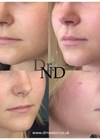
The examination revealed an asymmetrical lip support, along with ptosis and a ‘downturned smile’, caused by a loss of vertical height, as her previous dentist had ground her front teeth a few years ago for unknown reasons (Figure 9).

Figure 9 (Case 4): Before treatment.
The patient was advised and agreed to have HA filler not only in her lips but also in the perioral area (pyriform aperture, NLFs, labiomental fold, chin) to achieve a more relaxed and ‘happy’ appearance. The result was acceptable; however, the asymmetry, which was partly due to different lip support, persisted (Figure 10).

Figure 10 (Case 4): After treatment with fillers.
Therefore, the patient was suggested to undergo teeth alignment and a reestablishment of the lost vertical height through orthodontic treatment. The patient was unable to afford this approach and was also not keen on having any appliances in her mouth; consequently, prosthodontic options were proposed. Resin veneers were applied to her upper lateral incisors to achieve alignment, and composite fillings were placed on her posterior teeth to reestablish the lost vertical height, which was an affordable treatment option. At the end of the dental treatment, the asymmetry remained but appeared less pronounced (Figure 11).

Figure 11 (Case 4): After the teeth alignment and the reestablishment of vertical height.
Hence, attaining an optimal smile with a final session of HA fillers administered to the lips and the perioral region (NLFs, labiomental crease, chin, jawline) was feasible (Figure 12).

Figure 12 (Case 4): Final session with fillers.
Conclusion
When performing lip enhancement procedures, practitioners should consider not only the shape of the lips but also other relevant factors to achieve a harmonious and aesthetically pleasing smile. A thorough examination of the profile view, perioral region, gingiva and teeth in both rest and smiling positions should be conducted to provide patients with informed options, thereby facilitating an optimal outcome.
References
1. Sauter DA. The nonverbal communication of positive emotions: an emotion family approach. Emot Rev 2017;9(3):222–34.
2. Christou T, Betlej A, Aswad N, et al. Clinical effectiveness of orthodontic treatment on smile esthetics: a systematic review. Clin Cosmet Investig Dent 2019;11:89–101.
3. Kau CH, Christou T, Sharma S. Contemporary Smile design: an orthodontic perspective. Dent Clin North Am 2022;66(3):459–75.
4. Kar M, Muluk NB, Bafaqeeh SA, Cingi C. Is it possible to define the ideal lips? Acta Otorhinolaryngol Ital 2018;38(1):67–72.
5. Kempa J, Alfertshofer M, Chua D, et al. Influence of ethnicity on aesthetic preferences for lip characteristics in Caucasian male and female faces. J Plast Reconstr Aesthet Surg 2024;95:181–9.
6. Henderson A. Focusing on chin augmentation: treating the lower face using dermal filler. Journal Aesthetic Nursing 2020;9(5):191–4.
7. Mercado-García J, Rosso P, Gonzalvez-García M, et al. Gummy smile: Mercado-Rosso classification system and dynamic restructuring with hyaluronic acid. Aesthetic Plast Surg 2021;45(5):2338–49.
8. Sabri R. The eight components of a balanced smile. J Clin Orthod 2005;39(3):155–67.
9. Kokich VO, Kokich VG, Kiyak HA. Perceptions of dental professionals and laypersons to altered dental esthetics: asymmetric and symmetric situations. Am J Orthod Dentofacial Orthop 2006;130(2):141–51.
10. Cook R, Lim K. Update on perio-prosthodontics. Dent Clin North Am 2019;63(2):157–74.
11. Altin F, Muluk NB, Isci Dt KD, Cingi C. The relationship between lip augmentation and teeth visibility: a cosmetic perspective. J Craniofac Surg 2025 [Online ahead of print].
Declaration of competing interests: None declared.