Ageing of the perioral region is a multifactorial process that stems from underlying skeletal resorption, descent of soft tissues, dermal thinning and cumulative muscular activity [1]. These changes translate into several hallmark features: the philtral column elongates, the vermilion loses its eversion and may invert, and the oral commissures often turn downwards, giving rise to a fatigued or sad facial expression.
Conventional rejuvenation techniques, such as dermal fillers and botulinum toxin, can restore volume and attenuate dynamic rhytids effectively, but they have limited impact in reliably shortening the philtrum. Lip lift surgery remains the gold-standard approach for philtrum reduction; however, it entails surgical excision, potential scarring and recovery time [2].
By contrast, barbed thread lifting techniques, particularly where threads are anchored at the nasal base and passed submucosally over the philtral region to emerge above the vermilion border, offer immediate structural shortening. This method may achieve sustained results via fibrotic integration over time, promoting tissue tightening beyond the mechanical effect alone [3].
Case report
A 42-year-old female presented for perioral rejuvenation. She was an aesthetic practitioner by profession and had previously undergone dermal fillers, thread lifts and botulinum toxin treatment without complication. The following was noted upon consultation:
- Medical history: non-contributory
- Medications: none
- Allergies: none
- Pregnancy risk: none
- Herpes simplex virus (HSV) history: negative
- Screening: BDDD unremarkable
- Consent: fully informed, including discussion of risks, benefits, and alternatives.

Pre-procedure and immediate post-procedure frontal views.

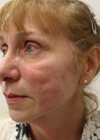
Two-week follow-up (frontal, oblique and lateral views).

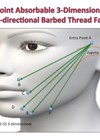
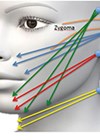
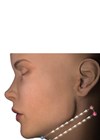
Schematic diagram of thread path and anchoring points.

Six-month post-procedure frontal view showing consistent, long-term outcome of thread lift to patient’s satisfaction.
Procedure
Perioral rejuvenation was undertaken using the Relife® poly-L-lactic acid (PLLA) double needle barbed thread, 12cm length, bidirectional.
Preparation
- Stat-dose oral prophylactic antibiotic administered (Clindamycin 150mg two hours preoperative)
- Sterile field prepared using sterile pack
- Skin cleansed with chlorhexidine
- Clinical photography obtained
- ‘Time Out’ safety protocol performed, including verification of resuscitation medications.
Anaesthesia
- Intra-dermal infiltration of lidocaine with adrenaline for adequate analgesia and haemostasis
- Topical anaesthesia deemed insufficient for submucosal passes.
Technique
- Step 1 – Central anchor placement
The double needle was introduced through a midline entry point at the nasal spine base to an equidistant central, non-barbed anchoring zone. - Step 2 – Lateral pass (one side)
From the same entry point, the needle was advanced submucosally at a 30–45° lateral angle, exiting just above the vermilion border. A free hand was used for tissue stabilisation. - Step 3 – Contralateral placement
The procedure was repeated on the opposite side, followed by gentle massage to activate and splay the barbs. - Step 4 – Cranial traction and trimming
The philthral column was lifted cranially under controlled tension. Excess thread was trimmed parallel to the skin to avoid exposure. - Step 5 – Optional oral commissure lift (advanced)
In the presence of commissure ptosis, a secondary submucosal pass can be made along the vermilion border to the commissure, re-entered, and directed back toward the nasal base using remaining barbed segments. - Step 6 – Final cleansing
All entry and exit points were cleansed, ensuring no residual thread exposure.
Aftercare protocol
- Avoid strenuous exercise and alcohol for 72 hours
- Maintain oral and perioral hygiene
- Avoid excessive lip stretching activities (wind instruments, forceful singing)
- Monitor for infection due to proximity to oral cavity.
Results
Immediate
- Philthral length reduced
- Vermilion eversion increased without volumising agents
- Symmetry maintained.
Short-term (less than two weeks)
- Mild-to-moderate bruising
- Mild pain and transient ‘tightness’ around upper lip/nasal base lasting approximately 12 days
- No functional compromise.
Discussion
This case demonstrates a novel perioral rejuvenation technique using double needle 12cm PLLA barbed threads for mechanical philthral shortening and vermilion enhancement. The dual mechanism of action, immediate barbed lift and delayed fibrosis, addresses structural ageing changes not easily treated with filler or neurotoxin.
Key considerations
- Anatomical complexity: The perioral region is highly vascular, innervated, and mobile; precision and advanced anatomical knowledge are essential.
- Bleeding risk: Profuse bleeding was observed; pre-procedure avoidance of alcohol, vigorous exercise, and anticoagulant substances is advised.
- nfection risk: Anchoring at the nasal base and proximity to the oral cavity require meticulous sterile technique and antibiotic prophylaxis.
Conclusion
This technique offers a promising, filler-free approach to perioral rejuvenation, achieving both immediate and sustained improvements in philthral height and vermilion show. Larger studies with long-term follow-up are warranted to establish reproducibility, longevity, and safety profile.
References
1. Shaw RB, Kahn DM. Aging of the midface bony elements: a three-dimensional computed tomographic study. Plast Reconstr Surg 2007;119(2):675–81.
2. Weiner RL, Orenstein A, Zelken J, Rohrich RJ. Philtrum shortening with micro-coring technology: a clinical study of perioral rejuvenation. Aesthet Surg J 2023;43(9):1035–47.
3. Bertossi D, Zamboni P, Verardi S, et al. Absorbable barbed threads for lifting and rejuvenation of the face: evaluation of outcomes in 150 patients. Aesthetic Plast Surg 2021;45(2):477–86.
Declaration of competing interests: While authoring this case report, all three authors were contracted as trainers for Relife (Menarini), who manufacture the barbed thread.